The EthicsMatters Values-to-Action System™

The EthicsMatters Values-to-Action System™: A Unified Organizational Approach to Biopharmaceutical Bioethics
LUANN E. VAN CAMPEN, PhD, MA-Bioethics
March 27, 2026
ETHICS + COMPLIANCE
What is the value of a unified organizational approach to biopharmaceutical bioethics? This question is best answered by asking an opposite question. What is the risk of not having a unified organizational approach to biopharmaceutical bioethics?
And that question is best answered by using a little imagination. Imagine this scene with product team members discussing a clinical trial design:
In the bustling conference room of a leading biopharmaceutical company, a group of key stakeholders gathered to discuss the design of a pivotal study. There was a tension in the air that often comes with a group of experts who are also highly opinionated. The Medical Director began the discussion.
"I think this study design hits all the marks," the Medical Director stated confidently. "It will give us the definitive answers we need to satisfy the regulators. If we don’t include all four of the study arms, there will always be unanswered questions about efficacy, safety, and health outcomes, which doesn’t benefit patients in the long run. Plus, this is the best design to assess genetic susceptibility to the disease. Knowing this will be very important for us to know so we can appropriately guide prescribers."
As he finished, the Regulatory Scientist interjected, a look of concern etched on her face. "I’m not comfortable with arms 1 and 3. I think we need more protections. If we don’t add the additional protections, it feels like we are using people to get the scientific data we want. I don’t think this is going to meet the requirements of an ethics review board."
The room fell silent for a moment, the weight of her words sinking in. The Statistician then spoke up, his tone measured but firm. "Statistically, I agree that the proposed study design will yield the purest results, but our company has high ethical standards. We are obligated to live up to those standards. We can’t ignore our company value to ‘Respect People’. Our mission is to improve patient lives, which includes patients in our studies. So, we need to change anything that doesn’t do that."
Nods of agreement spread around the table. The Clinical Operations Associate, who had been quietly listening, finally broke her silence. "I’m also not comfortable with arms 1 and 3. I don’t think you all are considering how much this disease affects people. My grandfather had it and it was really hard for my family."
Her personal connection to the disease added a poignant layer to the discussion, reminding everyone of the real human impact behind their decisions.
Yet, how would they ultimately decide?
Did you recognize that each team member brought a different ethical perspective to the study design discussion? What are the perspectives? Who is “right”? What is the best way to work through the issues being raised? If you can’t answer these questions, then you are operating as a Secret MoralAgent™, and you are not alone.
People who have moral capacity and capabilities are considered ‘moral agents’.
Many people, however, either are not transparent about or are unable to articulate values or methodology for working through ethical issues. They try their best to see and address bioethical challenges using personal training and abilities, but essentially they operate as Secret MoralAgents wearing dark glasses of uncertainty.
When an ethics problem is complicated, has potential for wide impact, and involves multiple stakeholders, it is not maximally effective nor efficient to conduct business without a unified organizational approach to biopharmaceutical bioethics. Without a unified approach, an organization risks wasting time and money as well as damaging stakeholder relationships. When a team utilizes a common bioethics lens that includes common vernacular and common deliberative methodology, they can confidently and consistently reach well-reasoned conclusions that move values to action.
This is the purpose for the EthicsMatters (EM) Values-to-Action System, a proprietary ethics system developed by the Founder and President of EthicsMatters LLC, Dr. Luann Van Campen.
The EthicsMatters Values-to-Action System™
The EM Values-to-Action System was conceptualized using systems thinking (Henning, Wilmhurst, & Yearworth, 2012; Kauffman & Kauffman, 2021) to answer the question, “How can people and organizations effectively, efficiently, and consistently move values to action?”
Based on her own experience, a review of academic and popular literature, and discussions with lay people and medical, scientific, bioethics, and business professionals, Dr. Van Campen concluded that a pragmatic ethics system requires two types of input and two types of processors to move values to action. The basic elements of the system are represented in the following figure. The full system is diagrammed and described in the Ethical Matters Learning Track of EthicsMatters ACADEMĒ (the training arm of EthicsMatters LLC).
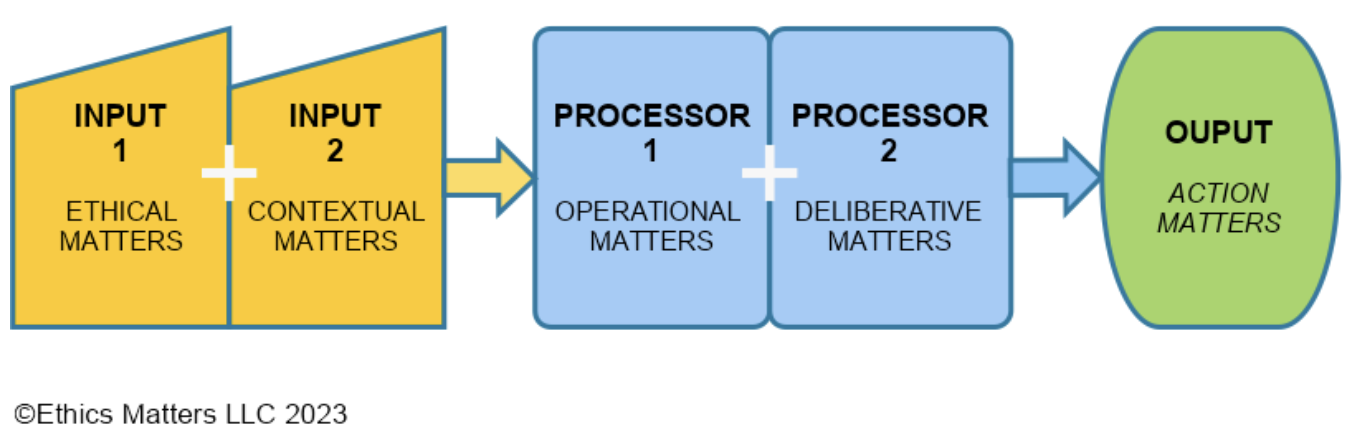
In brief, the system integrates foundational ethical standards with context-specific factors, guiding both routine operations and issue-specific deliberations to produce action and deliverables that matter. It can be used personally or organizationally and can be applied to any ethics specialty, including bioethics within biopharma.
Application to Biopharmaceutical Bioethics
The following explains how the EM_Values-to-Action System elements can be applied to a bioethics business system.
Input 1: Ethical Matters.
Ethical matters include fundamental ethics concepts for individuals and organizations that will be applied to a particular context. This encompasses organizational, leadership, and normative ethics.
Input 2: Contextual Matters.
Contextual matters include real-life factors that are relevant to a particular setting or problem. This encompasses life sciences, clinical, public health, and biopharmaceutical settings, as well as the characteristics of specific bioethical issues pertinent to those settings.
The combination of ethical and contextual matters fuels the two system processors
Processor 1: Operational Matters.
“Operational” means, “This is the way we routinely function as a matter of conviction.”
Purpose: The purpose of this processor is to cultivate a reputable collective moral attitude or ‘moral climate’ for an organization.
Activities: Operational activities facilitate the integration of bioethics thinking into an organization’s functional processes.
Processor 2: Deliberative Matters.
“Deliberative” means, “This is the way we resolve ethical problems as they arise.”
Purpose: The purpose of this processor is to facilitate ethical decisions that generate reputable behavior and deliverables.
Activities: Deliberative activities facilitate the integration of bioethics thinking into an organization’s decision-making processes.
The combination of operational and deliberative processing produces a targeted system output.
Output: Action Matters.
“Action” incorporates collective attitudes, behavior, and deliverables that align with ethical standards and advance an organization’s mission, vision, and values.
System Customization
Although the overall structure should remain constant across biopharma organizations, the details within the system are easily customizable to the needs and resources of individual organizations. For example, organizations may implement core activities in different ways and to different degrees. Likewise, organizations may place a bioethics system in different functional areas of the business (e.g., ethics and compliance or research and development) because of functional remits and reporting structures.
To explore how your organization could employ the EM Values-to-Action System, contact EthicsMatters, LLC to set up a time to discuss your needs and goals.
References
Henning, P. B., Wilmhurst, J., & Yearworth, M. (2012). Understanding systems thinking: An agenda for applied research in industry. Paper presented at the 56th Annual Meeting of the International Society for Systems Sciences (ISSS), San Jose, CA, USA.
Kauffman, D. L., & Kauffman, M. D. (2021). Systems 1: An Introduction to Systems Thinking (4th ed.): Center for Systems and Public Policy.
LUANN VAN CAMPEN is founder and president of EthicsMatters LLC, a company based in Indianapolis, Indiana providing bioethics and organizational ethics advisory and training services to biopharmaceutical organizations.